Who was the ramp for?
2026-11-15 · PLOT Team
At the kiosk
The line is long. Your turn finally comes. The screen shows dozens of items, and swiping just brings more. You can feel the people waiting behind you. You haven't decided yet. In the end you tap whatever is there.
A kiosk does two jobs in one place: deciding what to eat, and putting the order in. So the time you spend thinking becomes the time the person behind you spends waiting, and whoever chooses slowly gets stuck. Someone who can't read the small text. Someone seeing this screen for the first time. A traveler who doesn't speak the language. Someone whose mind goes blank when there are too many choices. These people aren't slow to begin with. The setup makes them slow.
The fix is old: a menu you can look at while you wait. It was put there for the slow chooser, and everyone in line reads it — in a shop you've never been to, everyone is the slow chooser.
The king who hated stairs
A short fable.
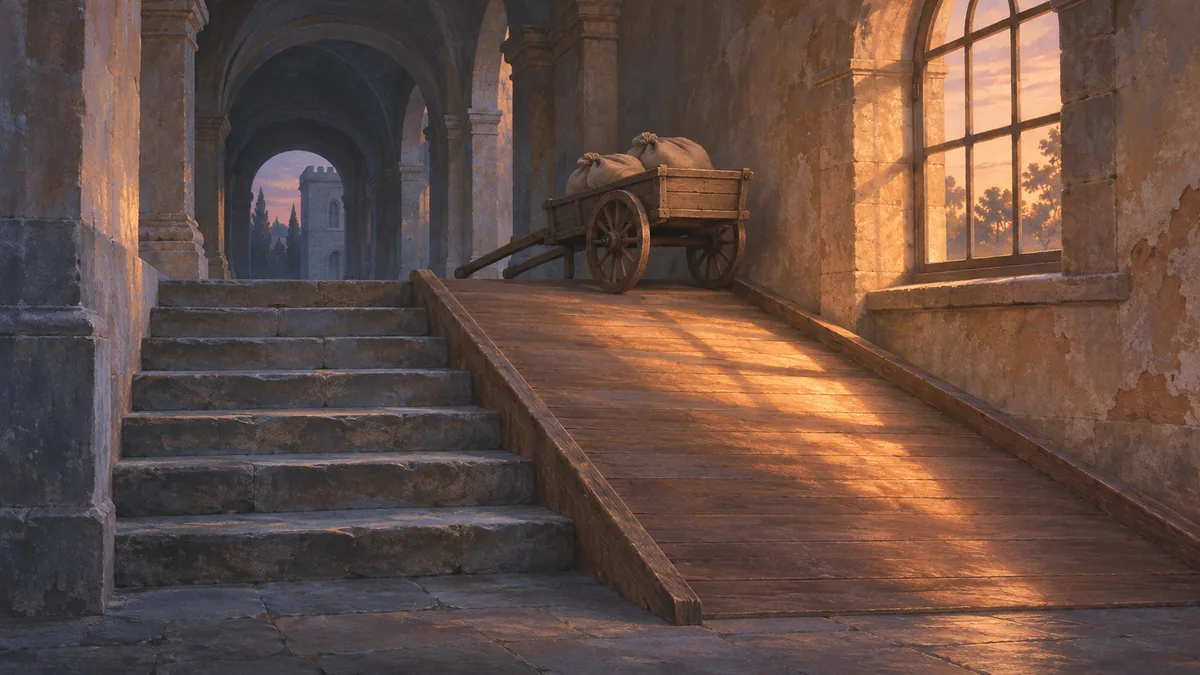
The king could not walk. So he ordered a ramp built beside every staircase in the palace. The ministers grumbled about throwing away taxes on just one man.
When the work was done, the first up the ramps were the ministers' carts.
The next day, the king ordered every threshold removed. The ministers grumbled again.
What the ministers got wrong wasn't the money. It was the count — "just one man." The ramp was built for the king, but it was also a path for whoever hauled the loads, for a servant with a hurt leg, for the aging ministers themselves. And when the king orders the thresholds removed, the ministers make the same count all over again.
It actually happened
Not only in fables.
In 1945, in Kalamazoo, Michigan, curbs were cut down at the request of Jack Fisher, a disabled veteran and lawyer — one of the earliest known examples. In 1972, Berkeley, California, put in its first official curb cut on Telegraph Avenue. Curbs lowered for wheelchairs are now used by strollers, suitcases, delivery carts, and bikes. The term for this is the curb-cut effect.
Subtitles are the same. They began as a way for people who couldn't hear the sound to follow along. In a 2021 survey commissioned by the UK charity Stagetext, 80% of 18- to 24-year-olds said they use subtitles some or all of the time when watching TV, and only about one in ten of them said they were deaf, deafened, or hard of hearing. The rest turn them on because it's noisy, because they don't want to miss a line, or just because it's easier.
So are books you listen to. In 1934, the Library of Congress began lending blind readers Talking Books recorded by the American Foundation for the Blind. The first recordings included parts of the Bible, the Declaration of Independence, and Shakespeare. One of the roots of the audiobook on your commute is there.
The line was never there
If you read these stories as "built for a few, turned out good for the many too," you've read only half. Read that way, there is still "them" and "us," and the work is worth doing only when it pays off for us as well.
Microsoft's inclusive design guide has an example: a person with one arm, a person with an arm injury, and a new parent holding a baby. All three run into the same problem. One for life, one for a few weeks, one for right now.
The traveler fumbling at a foreign kiosk is fast at home. The person whose eyes are tired tonight will be fine in the morning. The servant with the hurt leg will run up the stairs again once it heals. People are all a little different, and the same person is different from day to day.
So "who is this for?" is a question with no answer. The line the ministers drew — between one king and everyone else — was never there. A ramp isn't a gift for someone special. It's keeping the path that everyone uses level.
When you read a story, too
Stories in words are the same. Some people listen with a screen reader, some make the text large, some turn down motion on days when a moving screen is too much. The story stays the same; only the screen in front of it differs.
The PLOT apps follow the screen reader, text size, contrast, reduce motion, and dark mode settings you've turned on in your device. What they follow and how far is written down on our accessibility page.
Frequently Asked Questions
-
What is the curb-cut effect?
It comes from curb cuts — the dips in the sidewalk made so wheelchairs could cross the street, which ended up being used by strollers, suitcases, carts, and bikes too. It names the way something fixed for one group's difficulty becomes a path for many more people. The term was popularized by Angela Glover Blackwell's 2017 essay in the Stanford Social Innovation Review. But the point isn't only that many people benefit — it's that the line between the few and the many keeps moving.
-
Are accessibility features only for disabled people?
No. In a 2021 survey commissioned by the UK charity Stagetext, 80% of 18- to 24-year-olds said they use subtitles some or all of the time when watching TV, and only about one in ten of them said they were deaf, deafened, or hard of hearing. People use these features for all kinds of reasons, and nobody needs to ask which.
-
Why are kiosks so hard to use?
Partly because the screens are cluttered, but also because one machine does two jobs in one spot — deciding what you want and putting in the order. The time you spend thinking becomes the time the person behind you spends waiting, so the slower you choose, the more rushed you feel. A separate menu people can look at while they wait gives whoever is choosing the time to choose.
-
Can I read PLOT with a screen reader?
Yes. In the PLOT apps (App Store and Google Play) you can go from signing in to choosing a genre, reading, picking a choice, and writing your own line using VoiceOver or TalkBack. The apps also follow your device's text size, contrast, reduce motion, and dark mode settings. The accessibility page has the details.
Related
Why should an app follow my settings? · The thresholds before a story · PLOT accessibility