Why long AI stories need a story bible — and how to not need one
2026-09-13 · PLOT Team
- AI forgets because there is a limit to how much of your story it can hold at once.
- A story bible or codex fixes that by re-feeding the important parts on demand — which works, and costs you maintenance.
- The other approach is for the engine to keep the record itself, so nothing is entered by hand.
- Which you want depends on whether you are producing a manuscript or reading a story.
Open any tool built for writing fiction with AI and you'll find some version of the same feature. Sudowrite has a Story Bible. NovelCrafter has a Codex. Others call it a lore book, a world file, a series bible.
They converged on it because they all hit the same wall. It's worth understanding the wall before deciding whether you need the ladder.
The wall
A model can only consider so much text at once, and a long story doesn't fit. Past a certain length something has to choose what gets carried forward — and if nothing chooses deliberately, the oldest material goes first.
Which is exactly the material that matters. The sister introduced in chapter three, the rule that magic costs memory, the promise not yet broken. Established early, load-bearing, first out the door. (The mechanics of that, and what can be done about it, are their own subject.)
The story doesn't collapse loudly. It drifts, and by chapter twenty you're reading about people who never made those promises. Every tool in this category has hit that wall. What differs is the answer.
The story bible answer
A story bible solves this by not relying on the window.
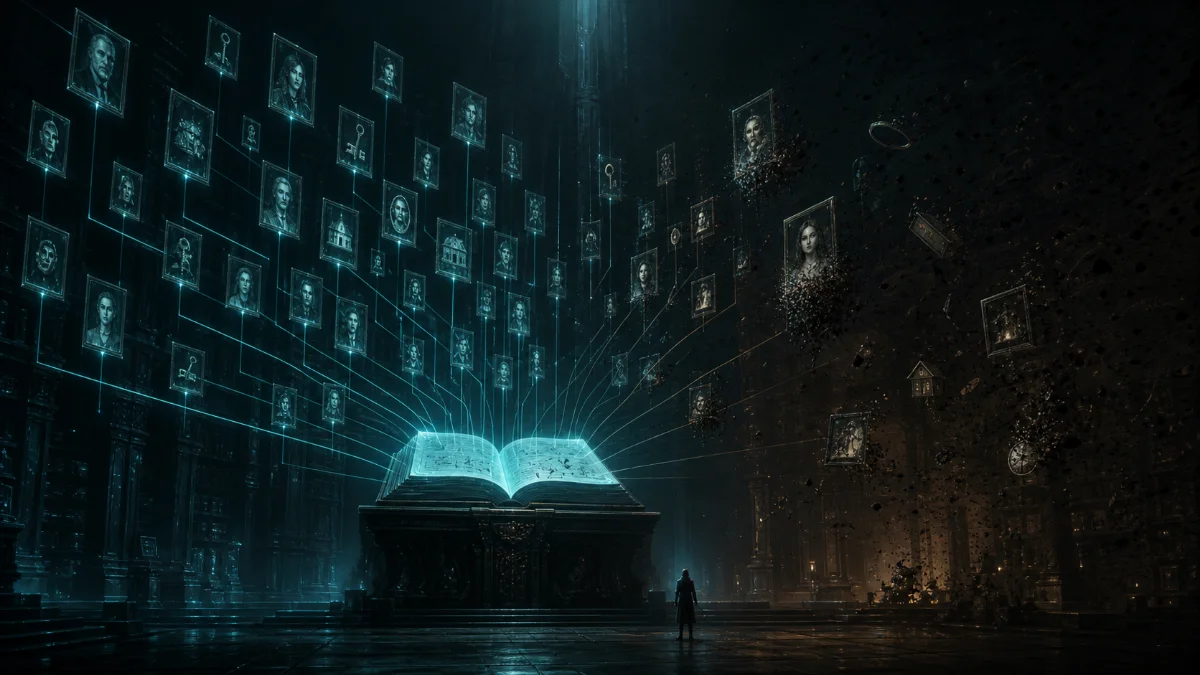
You write down the things that must stay true — who these people are, how the world works, what's already happened — in a structured record the tool can pull from. When it generates, the relevant entries go in alongside the recent text. The sister survives chapter twenty because she was never depending on chapter three still being visible.
This works, and for a manuscript it's the right shape of solution. It also gives you something a writer specifically wants: control over what the AI knows. You decide the entries. You decide what's canonical. When the model writes her wrong, you can look at what it was given and fix it there.
The cost is that it's a database and you're the one maintaining it. Entries have to be written, kept current, and reconciled when the story changes. That's real work, and it grows with the project. For people writing a novel, it's work worth doing — you were going to have to keep this straight anyway, and now it's written down.
The other answer
There's a different way to solve the same problem, and it only makes sense once you stop assuming the person is writing a book.
Instead of you authoring a record, the engine keeps one — extracting what the story established as it goes and carrying it forward. Nothing is entered by hand. The record exists because the story happened.
You give something up: you can't specify exactly what it retains, or hand-correct an entry, or enforce a rule the way you can by editing a codex. If that control is what you came for, this is the wrong trade.
What you get is that there's nothing to do before you start, and nothing to maintain while you go. For someone whose goal is to read a long story tonight, that's not a minor convenience — a setup step is the thing that ends the evening before it starts.
Which problem do you have
The two answers aren't competing. They're solving the same wall for different people.
- You're producing a manuscript. Author the bible. The control is the point, the maintenance is part of the job, and you need the story to stay consistent across months of work and possibly several books.
- You're reading a story. You want continuity without a project to manage. Let the engine hold it.
The failure mode is picking by feature and getting the wrong one. "Has a story bible" reads like more capability than "doesn't need one," the way a car with a manual transmission has more controls than one without. It's a real difference, and it's about who's driving, not about which is better equipped.
Where PLOT fits
PLOT takes the second approach. There's a short optional form at the start — a few characters, a situation — and no lore database behind it. You pick a genre and read, and the engine carries what the story set up so a detail from early on still lands later, without you writing any of it down.
It also means you can't hand it a structured world file or edit what it retains. If you want that, the writing tools are built for exactly it and this isn't a substitute.
What it's for is the long read where nobody has to keep the notes.
Frequently Asked Questions
-
Do I need a story bible, or is it overhead?
It depends on length and on what you're doing. Writing a novel over months, or a series, you need something that holds the canon steady, and a bible is the tool for it. Reading a story for an evening, you're paying setup cost for a problem the tool can handle for you. The mechanism underneath is the same either way — the question is whether you want to own the record or not have one to own.
-
What is a story bible in AI writing?
A structured record of your characters, places, and world rules that the tool can pull from when generating. Sudowrite calls it a Story Bible; NovelCrafter calls it a Codex. The mechanism is the same — instead of hoping the relevant facts are still in the window, they get supplied deliberately.
-
Do I have to fill one in myself?
In a writing tool, yes, and that's the point — you decide what the AI knows about your world. The alternative approach doesn't ask you to author a record at all; the engine keeps track of what the story established and carries it forward as you go. You trade fine-grained control for not having a database to maintain.
-
Is a story bible worth it for a short story?
Usually not. If the whole thing fits comfortably in one sitting, the model can hold it and you're paying setup cost for a problem you don't have. The value shows up when the story is long enough that early details are at risk.
-
I just want to read a long story without managing anything. Is that possible?
Yes — that's the other side of this. Continuity handled by the engine rather than by you is a design choice some apps make, PLOT included. You don't get to specify exactly what it remembers; in exchange there is nothing to fill in before you start.
Related
AI that doesn't forget the plot · How AI story memory actually works · NovelCrafter vs PLOT — manage the world, or go inside it?